Same-day, certified technicians for every brand and model — front load, top load, semi-automatic and washer-dryer combos. Transparent pricing, 30–90 minute response across Dubai, Sharjah and Ajman.
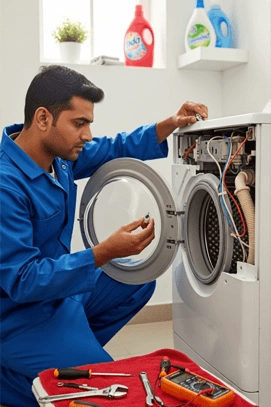
The Washing Machine Repair has completed more than 12,000 repairs across villas, apartments and staff accommodation throughout Dubai, Sharjah and Ajman, working on every major brand sold in the UAE — Samsung, LG, Bosch, Siemens, Whirlpool, Indesit, Ariston, Daewoo, Super General, Midea, Panasonic, Zanussi, Beko, Candy, Hoover, Elekta, Nikai and Haier. Our technicians are trained on the specific quirks of each brand, so a Bosch door-lock fault gets a genuine OEM part instead of a generic substitute, and a Samsung 5E code gets checked at the pump filter first instead of an unnecessary part replacement. Every visit starts with a full, honest diagnosis: you're told exactly what's wrong and what it costs before any repair work begins, never after — the same standard whether you're in a high-rise tower in Dubai Marina or a villa in Arabian Ranches. Each repair is backed by a 90-day warranty on both parts and labor, and our 5.0-star rating across 487 verified customer reviews reflects a simple approach: diagnose correctly, quote honestly, repair once. Call, WhatsApp, or book online above — a certified technician can typically reach you within 30–90 minutes, any day of the week.


Every visit starts with a full diagnostic so you know exactly what's wrong before we repair it — front load, top load, semi-automatic or washer-dryer combo.
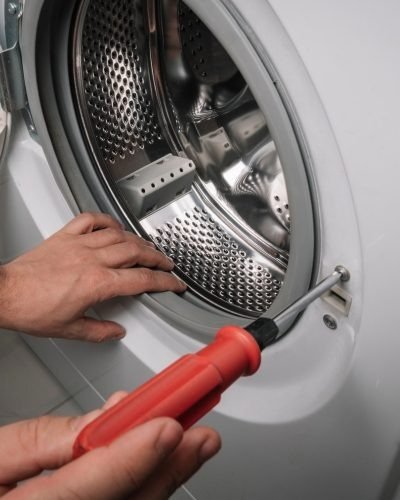

Belt, motor, carbon brush and drive-system diagnostics for drums that won't turn or spin unevenly.
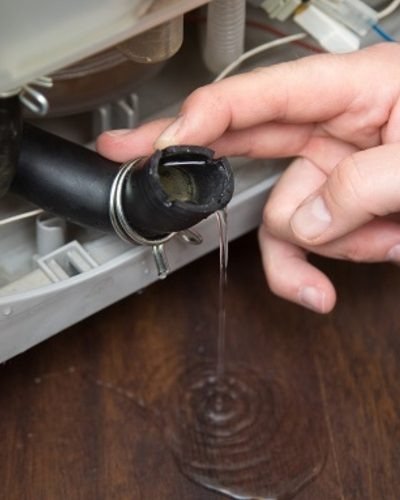

Door seal, hose, pump gasket and valve repair to stop leaks before they damage flooring.
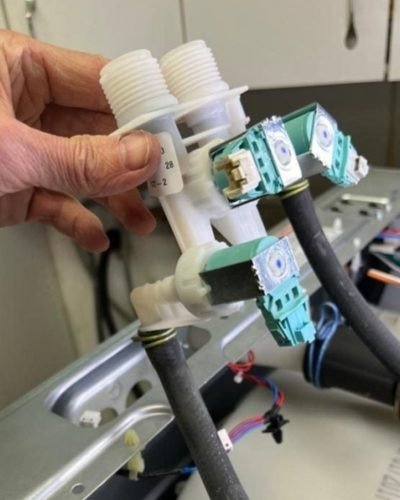

Brand-specific fault-code diagnostics for Samsung, LG, Bosch, Whirlpool and every major make.
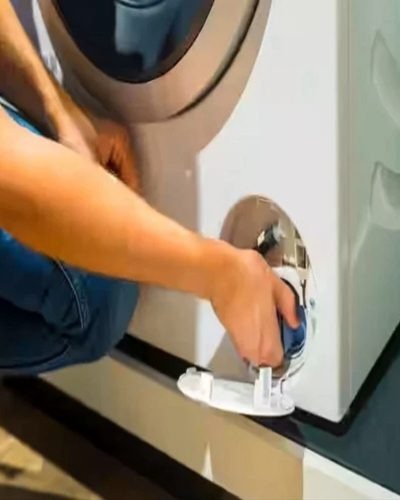

Shock absorber, suspension spring and drum bearing repair for excessive noise or shaking.
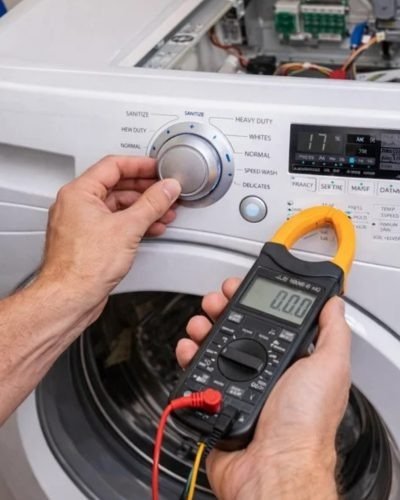

Control board diagnostics and component-level repair — often cheaper than a full replacement.
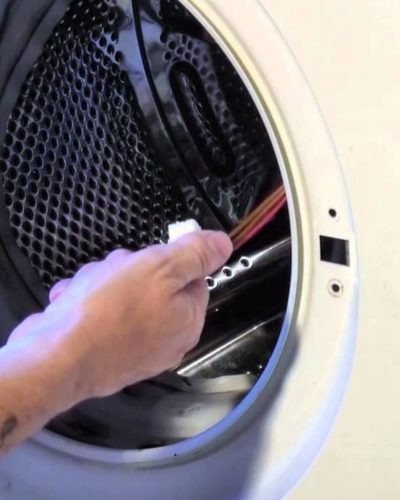

Door interlock, hinge and latch replacement so your machine locks and starts safely again.
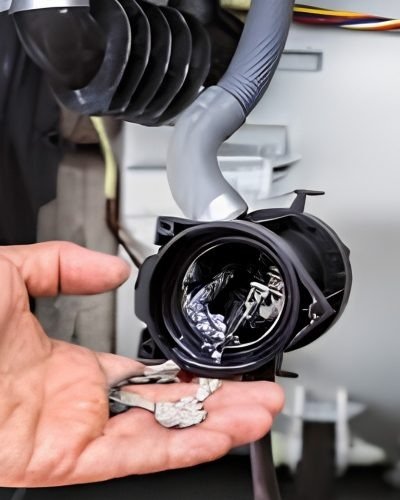
Blocked filter clearing and drain pump replacement so your machine drains properly every cycle.
From compact semi-automatic units to premium front-load washer-dryer combos.
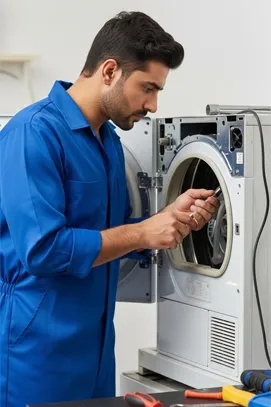
Front load specialists for door seal leaks, drum bearing wear and E-code diagnostics.
Tell us the code on your display and we'll bring the right parts on the first visit — no guesswork, no second trip.
Water supply issue — low pressure or closed inlet valve.
Drainage fault — blocked pump filter or drain hose.
Unbalanced load detected during spin cycle.
Door not detected as closed — door lock/latch fault.
Don't see your code, or the display is completely blank? WhatsApp us a photo of it and we'll identify the fault before we dispatch a technician.
We cover 190+ neighborhoods across Dubai, plus Sharjah and Ajman. Search your area below for local response times and technician availability.
Tell us your area, brand and the issue you're seeing.
A certified technician reaches you in 30-90 minutes with genuine parts.
Upfront price, same-visit repair, and a 90-day warranty on the fix.
"Technician reached my villa in JVC within 40 minutes and fixed the drum bearing same day. Transparent pricing, no surprises."
"LG washer was throwing a UE error. Diagnosed and repaired the PCB board in one visit. Highly recommend."
"Called on a Friday evening, expected to wait days. A technician was at our apartment in Al Nahda Sharjah within the hour."
Most washing machine repairs in Dubai range from AED 150 to AED 450 depending on the fault. Minor issues like door locks or drainage pumps start around AED 150-180, while PCB board or motor repairs range from AED 350-650. Diagnosis is free when you proceed with the repair.
Yes. We offer same-day and emergency washing machine repair across Dubai, Sharjah and Ajman, with technicians typically reaching most areas within 30-90 minutes of booking.
We repair all major brands sold in the UAE including Samsung, LG, Bosch, Siemens, Whirlpool, Indesit, Ariston, Daewoo, Super General, Midea, Panasonic, Zanussi, Beko, Candy, Hoover, Elekta, Nikai and Haier, across front load, top load, semi-automatic and washer-dryer combo models.
Yes. In addition to all Dubai neighborhoods, our technicians cover Sharjah (including Al Nahda, Al Majaz and Al Qasimia) and Ajman (including Al Nuaimiya and Al Rashidiya).
Error codes vary by brand, but commonly E1/E2 indicate water inlet or heating faults, and UE/UB indicate an unbalanced load or suspension issue. Our technicians carry brand-specific diagnostic tools to identify the exact fault on-site.
Every repair includes a 90-day warranty covering both parts and labor, so if the same issue recurs, we return free of charge.
Quick Answer
Most washing machine faults in Dubai — drum not spinning, water leaking, error codes, loud noise, door lock failure, or drainage problems — fall into a short list of causes: worn drum bearings, blocked pumps, faulty door interlocks, or PCB board failures. A same-day technician can usually diagnose the exact cause on-site within minutes and complete the repair in a single visit, often for less than the cost of replacing the machine.
In This Guide
A washing machine is one of the few appliances that, when it fails, disrupts a household immediately — there's no waiting a week to deal with it when you have a hamper full of laundry and a family that needs clean clothes for work and school. Whether you're renting an apartment in Business Bay, running a villa household in Arabian Ranches, or managing a building in Sharjah, the questions are the same: what's actually wrong, is it worth fixing, and how fast can someone reliable get here?
This guide exists to answer those questions properly — not with a generic list of "5 washing machine tips" recycled from a hundred other sites, but with the kind of detail you only get from technicians who've spent years opening these machines up across UAE homes. We'll walk through what each warning sign actually means, how repairs differ by brand and machine type, what a fair repair visit looks like from start to finish, and when replacing the unit genuinely makes more financial sense than repairing it.
By the end, you'll be able to describe your fault accurately to a technician (which speeds up diagnosis and avoids unnecessary parts being ordered), understand roughly what's driving the cost of your repair, and know the maintenance habits that keep a machine running for eight-plus years in the UAE's hard water and high-heat conditions.
Before diagnosing anything, it helps to understand that washing machine faults cluster into a handful of systems. Almost every service call falls into one of these categories:
Here's why this matters practically: a technician's first questions (“does it make noise before or during spin?”, “does it leak from the front or underneath?”, “is there an error code, and when does it appear?”) exist to sort your problem into one of these four buckets before a single screw is removed. Answering them accurately is the single biggest thing you can do to shorten your repair visit — it's the difference between a technician arriving with the right part already in hand and a machine that needs a second visit.
It also explains why two households can describe what sounds like "the same problem" — a noisy machine, say — and end up with completely different repairs. One noisy machine might be a mechanical bearing issue; another might be an unbalanced load that's really a user-pattern issue solved by redistributing the wash rather than replacing a part. The symptom on its own rarely tells the full story; the timing, consistency and accompanying signs (smell, leaking, error codes) are what narrow it down to an actual root cause. That's the mindset this guide is built around: not a single universal fix, but a way of reading your specific machine's behavior accurately enough to get the right repair the first time.
Not all washing machines fail the same way, because they're mechanically different. If you know which type you own, you already know roughly where to look.
The dominant type across UAE apartments and villas. Front loaders use a horizontal drum, a rubber door gasket, and typically a counterweight-and-spring suspension system to control vibration.
Common in villas and larger households, especially older-generation units and certain Korean and American brands.
Still widely used in staff accommodation, smaller apartments, and budget-conscious households, particularly Super General, Nikai, and Elekta models.
Popular in space-constrained apartments across Dubai Marina, JLT, and Downtown, from brands like Samsung, LG, Bosch and Haier.
Every brand has a personality when it comes to failure patterns, shaped by its engineering choices. Here's what our technicians see repeatedly across UAE households, brand by brand.
Samsung's Diamond Drum and AddWash ranges are reliable mechanically but electronics-heavy. The most frequent calls are for 4E/4E2 water inlet errors (often just a kinked or low-pressure supply hose, not a real fault), 5E/5C drainage errors from lint and coin buildup in the pump filter, and UE unbalance codes tied to worn suspension springs after 4-5 years of use.
LG's Direct Drive motor is genuinely durable — direct-drive units rarely fail outright — but the UE (unbalance) and OE (drain/overflow) codes are common, usually from a clogged drain filter rather than the motor itself. LE (motor lock) errors are less frequent but usually point to a PCB or wiring harness issue rather than the motor.
Both brands (same parent company, similar internals) are known for tight tolerances and quieter operation, but that precision means components like the door lock assembly (F42/F63 codes) and drain pump (E:03/F43) need genuine replacement parts — generic parts often cause recurring faults on these models.
Whirlpool units commonly show F05/F06 drain-pump and motor-sensor faults, and on older units, heating element failure (F08/F09), which shows up as clothes coming out cold or cycles running unusually long.
Both share Whirlpool-group engineering. Their most common issue in UAE homes is door interlock failure — the plastic door catch is a known wear part — followed by drain pump blockages, especially in units that have run for years without the filter ever being opened.
These budget-friendly and semi-automatic-favorite brands see more timer and motor-brush wear than electronic faults, since many models (especially semi-automatics) use simpler mechanical controls. Motor brush replacement is a routine, low-cost fix that's often mistaken for "the motor is dead."
Common on washer-dryer combos. The dominant complaint is drying performance dropping over time, almost always traced to a blocked condenser or lint trap rather than the heating element itself.
These European-market brands are common in older apartment buildings. Their recurring faults are door seal cracking (especially in units running hot washes frequently) and carbon brush wear on the drum motor, both of which are inexpensive, fast repairs when caught early — but expensive if left until the motor itself is damaged.
Why brand knowledge matters: a technician who knows that Bosch requires OEM door-lock parts, or that Samsung's 5E code is almost always a filter issue rather than a pump replacement, saves you from paying for parts you don't need. This is the practical value of using a technician who services all brands regularly rather than one who specializes in a single manufacturer.
These are the seven issues we get asked about most. For each, here's what's actually happening, what you can safely check yourself, and when to stop and call a professional.
What's happening: Either the drum isn't receiving power/drive (belt, motor, or motor-control board fault) or it's being deliberately prevented from spinning (door not detected as locked, or the load-balance sensor has stopped the cycle).
Safe checks: Confirm the door is fully closed and latched. Check whether the machine is mid-cycle on a "soak" or "delay" phase (not actually stuck). Look for a visible belt through the rear service panel if you're comfortable removing it — a snapped or slipped belt is visually obvious.
Call a technician when: you hear the motor humming but the drum doesn't turn (a strong sign of a broken belt or seized bearing), or there's a burning smell (motor or PCB damage risk).
What's happening: Roughly 70% of leaks trace to the door seal/gasket (a tear, a trapped object, or a hardened seal that's lost its flex) or the drain hose connection. The rest are typically the water inlet valve, a cracked detergent drawer housing, or — less commonly — a cracked outer drum tub.
Safe checks: Run your hand around the full circumference of the door gasket feeling for tears or embedded objects (coins, underwire, small toys). Check that the drain hose clamp at the back is tight and the hose itself isn't cracked.
Call a technician when: the leak appears to come from underneath the machine rather than the front (this usually means a pump or tub-seal issue that requires disassembly), or the leak only happens during the spin cycle (a strong sign of a worn tub bearing seal).
What's happening: Modern machines run self-diagnostics constantly. A code is the machine telling you which sensor tripped — but the same code can have multiple root causes (see the Brand-by-Brand section above for specifics).
Safe checks: Note the exact code and whether it appears at the start, middle, or end of a cycle — timing is a major diagnostic clue. Power-cycle the machine once (unplug for 60 seconds) since a small number of codes are sensor glitches that clear on reset.
Call a technician when: the code recurs after a reset, or the manual/manufacturer support page for your model doesn't resolve it with a simple fix (most codes beyond "check the door" or "check the water supply" require a technician).
What's happening: New, sudden loud noise during spin is almost always mechanical — worn drum bearings (a deep rumbling or grinding sound that gets louder over weeks), a failed shock absorber or suspension spring (banging or the machine "walking" across the floor), or foreign objects trapped between the drum and outer tub.
Safe checks: Confirm the machine is level (all four feet touching the floor evenly — a common, free fix) and that nothing was left in pockets. Listen for whether the noise happens throughout the cycle or only during high-speed spin.
Call a technician when: the noise is a grinding or grating sound specifically during spin — this is the classic signature of drum bearing failure, and running the machine further in this state risks damaging the outer tub, turning a moderate repair into an expensive one.
What's happening: The PCB is the machine's brain. Faults here range from a single burnt relay (cheap, fast fix) to full board failure from a power surge or long-term moisture exposure (more involved, sometimes a board replacement).
Safe checks: None recommended — this is not a DIY-safe area given the electrical risk and the cost of a wrongly-diagnosed board swap.
Call a technician when: the machine won't power on at all, resets to factory settings on its own, mixes up which cycle is running, or shows multiple unrelated error codes in sequence — all signs pointing to the control board rather than a single mechanical part.
What's happening: A safety interlock prevents the door opening mid-spin. The interlock itself (a small electromechanical or thermal-fuse-based part) is a known wear component across nearly every brand, typically failing after 1,500–2,500 wash cycles.
Safe checks: Confirm the door is pushed fully closed until it clicks. If the door won't open even with the machine off and unplugged for several minutes, do not force it — thermal interlocks can take a few minutes to release after power loss.
Call a technician when: the door won't lock (cycle won't start) or won't unlock after the cycle finishes and enough cooldown time has passed — both point to interlock replacement.
What's happening: Water not draining is overwhelmingly a blocked pump filter (coins, buttons, hair, small socks) rather than a failed pump motor. True pump motor failure is less common but does happen after years of use.
Safe checks: Locate the pump filter access panel (usually a small flap at the bottom-front of the machine), place a shallow tray underneath, and open it slowly to check for blockages — this is one of the few genuinely DIY-safe fixes.
Call a technician when: the filter is clear but the machine still won't drain (points to the pump motor or a blocked drain hose further down the line), or you hear the pump motor running/humming but no water moves.
Theory is useful, but these faults make more sense when you see how they actually play out in a household. These three composite scenarios reflect the kind of calls that come up again and again across UAE homes.
A homeowner in Jumeirah Village Circle reported their Samsung front loader wouldn't start — no error code, no response at all when the start button was pressed. The assumption was a dead PCB and a costly board replacement. On inspection, the actual cause was simpler: the door hadn't been closing far enough to trigger the interlock switch, because a small buildup of detergent residue around the latch mechanism was preventing it from seating fully. A five-minute clean of the latch area and the machine started immediately. The lesson: a "no response at all" symptom feels like the most serious possible fault, but it's worth ruling out the door interlock before assuming the control board has failed — it's a far cheaper and faster fix when that's the actual cause.
A Samsung washer-dryer combo in a Jumeirah Beach Residence apartment was taking two to three times longer than normal to dry a load, with clothes still damp at the end of the cycle. The household assumed the heating element had failed and was prepared for a costly repair. The actual cause was a condenser unit clogged with two years of accumulated lint that had never been cleaned — a maintenance item, not a failure. After cleaning the condenser, drying performance returned to normal within one cycle. The lesson: on combo units especially, a drying-performance complaint should always start with the condenser and lint trap before any electrical component is suspected, since this single point of neglect is responsible for the majority of drying complaints on these machines.
A household in Al Nahda, Sharjah, had a Bosch front loader that leaked intermittently — not every wash, which made it hard to pin down. A generic replacement door seal had been fitted a few months earlier by a previous technician, and the leak had returned. On reinspection, the generic seal didn't sit flush against the Bosch drum's specific lip profile, causing a slow, inconsistent leak that only showed up on certain load sizes. Replacing it with a genuine Bosch OEM seal resolved the issue permanently. The lesson: this is the clearest illustration of why OEM parts matter on precision-engineered brands — the generic part wasn't defective exactly, it simply wasn't shaped correctly for that model, and the cost difference between the two seals was small compared to paying for two separate service visits.
| DIY Fix | Professional Repair | Full Replacement | |
|---|---|---|---|
| Best for | Filter blockages, leveling, gasket debris removal | Bearings, PCB, motors, pumps, interlocks, leaks | Machines 8+ years old with recurring, unrelated faults |
| Difficulty | Low (if limited to filter/leveling/visual checks) | N/A — handled by a trained technician | N/A — logistics only |
| Typical Cost | Free–low (your time only) | Moderate (parts + labor, single visit) | High (unit cost + installation + old unit removal) |
| Risk Level | Low if limited to non-electrical checks; high if attempting PCB, motor or drum disassembly without training | Low — diagnosed and warrantied | None (new unit) |
| Time to Resolve | Minutes | Usually same-day, single visit | 1–3 days (ordering, delivery, installation) |
| Performance After | Fixes only the specific minor issue | Restores to full original performance | Best-case performance, plus efficiency/warranty benefits of a new unit |
| Recommended For | Confident homeowners tackling filter/leveling issues only | Anyone with a mechanical, electrical or water-system fault | Older machines, or where repair cost approaches 50%+ of a new unit's price |
The practical takeaway: DIY is genuinely useful for exactly two things — clearing a pump filter and leveling the machine. Everything else (bearings, PCB, motors, seals, interlocks) involves either electrical risk, specialized tools, or a real chance of turning a moderate fault into a total loss if handled incorrectly. That's not a sales pitch; it's simply where the actual risk-to-savings ratio sits for a household appliance.
Knowing what a proper repair visit should look like helps you evaluate whether a technician is doing a thorough job.
If a technician skips step 4 (quoting before repairing) or step 6 (testing after repair), that's worth flagging — those two steps are what separate a reliable repair from a callback waiting to happen.
Before booking a technician, these checks take under five minutes and either resolve the issue or make your technician's job faster:
Stop here. Anything beyond this point — removing panels to access the motor, drum, or PCB — carries real electrical and mechanical risk and is where professional repair takes over.
Repair pricing isn't arbitrary — it's driven by a small number of factors, and understanding them helps you sanity-check any quote you receive.
A fair repair quote should always follow a free or low-cost diagnostic visit, be confirmed before any work begins, and be backed by a warranty on both parts and labor — typically 90 days is a reasonable standard in the UAE market.
Not every technician who shows up with a toolbox is equally qualified, and since this is a service you're trusting with an expensive appliance and access to your home, it's worth knowing what actually separates a reliable provider from a risky one.
None of these individually guarantees a good outcome, but a provider that clears all seven is very unlikely to leave you with a recurring fault or a surprise bill.
Repairing a washing machine in the UAE isn't identical to doing it anywhere else — local conditions genuinely change what breaks and how often.
Tap water across Dubai, Sharjah and Ajman is treated desalinated water, but mineral content and building-level plumbing can still leave scale buildup inside heating elements and valves over time, particularly in villas with older internal plumbing or units that don't get descaled periodically. This is a leading cause of reduced heating performance and inlet valve faults that isn't obvious until the machine is opened up.
Villa laundry rooms often have longer supply and drain hose runs than apartment utility closets, which increases the chance of kinked hoses or slow drainage — worth checking first if a villa machine develops a drainage fault. Apartment installations, especially in older towers, sometimes have shared or narrower drain lines that back up more easily, which can mimic a pump fault when the real issue is downstream.
Ambient heat in laundry areas — especially maid's rooms or external utility spaces during summer months — accelerates rubber component aging (door seals, hoses) compared to temperate climates. Machines installed in non-air-conditioned utility spaces typically need seal replacement somewhat sooner than those in cooler indoor locations.
In most UAE rental arrangements, whether the landlord or tenant covers a repair depends on the tenancy contract and whether the appliance was provided furnished by the landlord or brought in by the tenant — this is a contractual question, not a technical one, so it's worth checking your Ejari/tenancy agreement before booking if you're unsure who's responsible for the cost.
Dubai, Sharjah and Ajman are close enough geographically that response times for a mobile technician network are broadly similar across the three emirates, though areas further from central dispatch points (such as Hatta, Al Lisaili, or industrial zones) may see slightly longer arrival windows than central neighborhoods.
Every fault covered above becomes less likely — and cheaper when it does happen — with a handful of habits.
Maintenance needs aren't perfectly evenly spread across the year. Household laundry volume typically spikes during the summer school-holiday period (more casual clothing, beachwear and towels washed more frequently) and again around major family gatherings, which is exactly when a machine running near its limit is most likely to reveal a weak component. It's worth doing a quick filter-and-seal check before these higher-usage periods rather than after a fault appears mid-cycle. Machines in external or non-air-conditioned utility spaces also benefit from a seal inspection heading into the peak summer months, since sustained high ambient heat is what accelerates rubber component aging fastest.
A fault doesn't have to stop the machine from running to cost you money — several common issues quietly increase your utility bills long before the machine fails outright.
None of these show up as a dramatic, obvious fault — they show up gradually on your DEWA bill. This is one of the more overlooked reasons to address a "minor" issue promptly rather than letting it run in the background: a machine that's technically still working can still be costing you more every month than the repair itself would.
This is the question every homeowner eventually faces, and it deserves a real framework rather than a rule of thumb.
Lean toward repair when:
Lean toward replacement when:
A simple gut-check many technicians use: if the repair cost is under roughly 30–40% of a new equivalent machine's price and the unit is under 7 years old, repair is almost always the better financial decision. Above that threshold, or on a machine already past its expected service life, replacement starts to make more sense.
Whether you're replacing a faulty unit, moving between apartments, or setting up a new villa laundry room, correct installation prevents a large share of the faults covered earlier in this guide before they ever start.
A proper installation includes leveling all four feet, connecting the inlet hose with a fresh washer/seal (not the old one from the previous machine), securing the drain hose at the correct height (typically 60-100cm, since positioning it too low can cause siphoning issues and constant slow leaking), and removing any transit bolts from the rear panel — a step that's easy to forget and one of the most common causes of extreme vibration and noise the very first time a new machine runs.
Moving a washing machine, common across Dubai's high rental turnover, requires draining any residual water from the drum and hoses first, and reinstalling the transit bolts before the move to protect the drum suspension from shock damage in transit — skipping this step is a frequent, avoidable cause of suspension spring damage in machines that arrive at a new home "not working" despite having worked fine before the move.
When retiring an old unit, disconnecting the water supply at the wall (not just the machine) and confirming the drain line is capped prevents water damage in the interim before a new unit is connected. If the fault that ended the machine's life was electrical or motor-related, it's also worth having it uninstalled by someone familiar with appliance wiring, rather than a general mover, to avoid damage to the surrounding electrical connection point.
Things most homeowners only learn after their third or fourth repair call:
A quick reference for terms used throughout this guide and by technicians during a repair visit:
You can safely check and clean the door seal and tighten the drain hose clamp — these resolve a meaningful share of leaks. If the leak persists or appears to come from underneath the machine rather than the door, that typically points to a pump or tub-seal issue that needs professional disassembly.
A pump issue usually shows as a drainage failure with the machine otherwise running normally — you may hear the pump humming without water moving. A motor issue usually shows as the drum failing to spin at all, or spinning with unusual noise, while draining still works fine. Describing which of these you're seeing helps a technician diagnose faster over the phone.
It depends on the specific fault and repair cost relative to the price of a new equivalent unit. A single, inexpensive fix (like a door lock or filter) is usually still worth it even on an older machine. A major fault like a cracked outer tub or full motor failure, on a unit already past typical service life, is usually where replacement becomes the better financial decision.
Odor is almost always separate from mechanical faults — it comes from moisture and detergent residue trapped in the door seal or drum. Wiping the seal dry after each wash, leaving the door ajar between uses, and running a monthly hot maintenance cycle typically resolves it within one to two washes.
Yes, over time. While UAE tap water is treated, mineral buildup can still accumulate in heating elements, valves and hoses, especially in units that never get a maintenance wash. This shows up as reduced heating performance or inlet valve faults well before the machine's expected end of life.
For daily-use households, roughly once a year is a reasonable interval. For lighter use, every 18–24 months is typically enough. Regular light maintenance (filter cleaning, seal wiping, monthly hot cycle) matters more day-to-day than a formal annual service, but the service itself catches early-stage wear — like a bearing just starting to loosen — before it becomes a bigger repair.
A diagnostic visit is where a technician identifies the exact fault; a repair quote is the confirmed cost to fix it, given after diagnosis and before any work begins. Many technicians waive the diagnostic fee entirely if you proceed with the repair, so it's worth asking upfront.
Yes, but using a third-party (non-manufacturer-authorized) technician on a machine still under manufacturer warranty can sometimes affect that warranty's validity, depending on the manufacturer's terms. If your machine is less than a year or two old, it's worth checking your warranty terms or contacting the manufacturer's authorized service network first.
This depends on your tenancy contract and whether the machine was provided by the landlord as part of the furnished unit or brought in independently by the tenant. It's a contractual matter rather than a technical one, so checking your Ejari agreement or asking your landlord/property manager before booking avoids disputes over who covers the cost.
Most single-component repairs — door locks, pump filters, inlet valves, PCB relays — are completed within 45–90 minutes on-site once the fault is confirmed. More involved repairs, like drum bearing replacement requiring partial disassembly, can take longer, sometimes 1.5–3 hours, depending on the model and how accessible the machine is.
Most washing machine problems are more predictable — and more fixable — than they first appear. A drum that won't spin, a leak, a flashing error code, or a machine that suddenly gets loud almost always traces back to one of a handful of known components: the door seal, the pump filter, the drum bearings, the door interlock, or the control board. Knowing which bucket your symptom falls into won't replace a proper diagnosis, but it will help you describe the problem accurately, sanity-check any quote you receive, and know when a five-minute DIY check is enough versus when it's time to call a professional.
If your machine is relatively young and the fault is a single, well-understood component, repair is almost always the right financial call — often completed in a single same-day visit. If you're facing your second or third major repair on a machine already past 8 years old, it's worth weighing that cost against a replacement rather than continuing to patch an aging unit.
The practical takeaway: don't wait for a grinding bearing to become a cracked tub, or a small leak to become water damage. Catching these issues early — through basic maintenance and prompt repair — is consistently the cheapest and least stressful path, whether you're in an apartment in Dubai Marina, a villa in Arabian Ranches, or a building in Sharjah or Ajman.
If there's one habit worth taking from this entire guide, it's this: describe the symptom precisely (what you hear, when it happens, and any code on the display), do the five-minute safe checks first, and don't let a small, well-understood fault sit unaddressed simply because the machine still technically runs. That single shift — from reactive to slightly proactive — is what separates a household that gets 10+ years out of a washing machine from one that's replacing units every four or five years. When you're ready, book a technician or reach us on WhatsApp for same-day service anywhere in Dubai, Sharjah or Ajman.
